Writing Advice That Gave Me Goosebumps (FightWrite™)
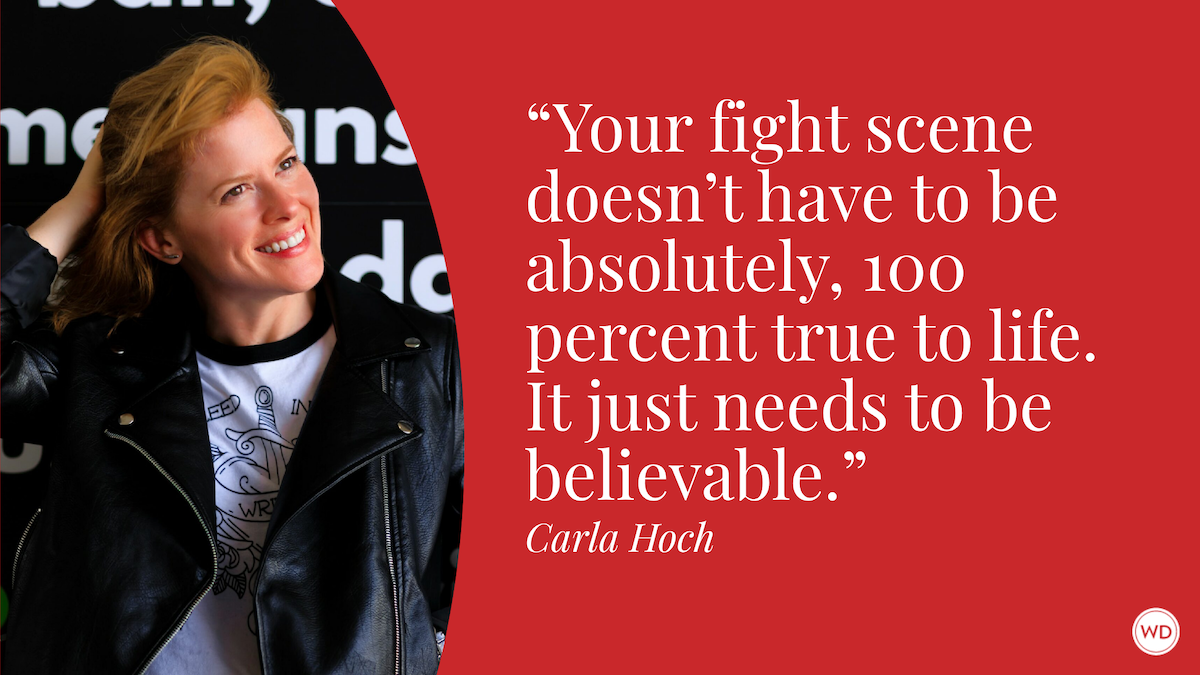
This month, trained fighter and author Carla Hoch shares the best writing advice she heard this year and how to train our brains to be creative instead of fearful.
This past year I had the pleasure of teaching at some wonderful conferences, to include Writer Digest’s. I absolutely love writer’s conferences. You form professional connections and forge personal bonds. You learn from some of the industry’s best in-person, which reminds you that they are, in fact, a person, just like you. You leave tired to the bone yet energized to your soul. And, if you’re especially blessed, you learn things that go far beyond the world of writing. This year, I was just that blessed. I got some advice so good that it gave me goosebumps.
I have two favorite Bobs. I met both at writer’s conferences this year, and both carry the last name [stahyn]. I write that phonetically as each one spells it a little different. I also point it all out because what are the odds of that? Two Bob [stahyn]s met at conferences?
One of the Bobs is Bob Eckstein. We met at the WD conference. He is a brilliant artist, funny writer, wonderful walking buddy, and an all-around delight of a human. My other favorite Bob is Bob Stine who I met at Thrillerfest. You might know him better as R.L. Stine.
If you have never seen Bob “R. L.” Stine in an interview or heard him speak, it would be easy to imagine him as, well, creepy. He writes books about killer dolls, haunted houses, werewolves, cursed masks. Heck, he has a whole book series known as Fear Street. If the subject is spine-tingling enough keep you up at night both reading and fearing sleep, Bob Stine has probably written on it.
Amazon
[WD uses affiliate links.]
Before the conference began, I asked my co-teacher, Jason Allison, which sessions he would suggest I attend. Jason and I taught a class on fight scenes together and he’s a Thrillerfest vet. He has heard many authors speak and could quickly scan the schedule and point out some of his favorites, one of which was R. L. Stine.
“Go to Bob’s. Super nice man. You’ll like him a lot. He’s kind of…” Jason thought then shrugged and said, “He’s kind of cuddly.”
Cuddly? Writers, Jason is a former ATF agent and looks the part. He’s tall and imposing. Cuddly isn’t a word you’d imagine him saying at all must less as an adjective for a horror writer.
Eight rows back from the stage on which R. L. Stine was being interviewed, I had to agree. Bob Stine is, in fact, kind of cuddly. His resting expression is a smile. He laughs easy and jokes quite a bit. He’s very endearing and makes you feel like you know him. He’s kind of like a sweet neighbor who bakes you some cookies then jokes that his cooking has never killed anyone because he is always sure to pull its teeth out before he serves it. Then he walks home and writes a book about a cookie that eats people and it sells one billion copies because it is that good. Your kids read it twice. That’s Bob Stine.
During his session, Bob gave several pieces of writing advice, all of which were very practical. The one that stuck with me is one that I have never heard any other decorated author say. Scoot closer to your screen. You’re going to want to remember this.
Bob Stine pointed his thumb toward the door and said that if you go to a writing class and the teacher talks about how hard writing is, get up and leave. Writing is not hard. It’s just not.
He went on to explain that if we get into our heads that writing is hard, then every time we sit down to write, it will be hard. We have to look at it as easy and enjoyable so it will be. Does that mean it won’t be tough sometimes? No. It does mean that it won’t be tough because we have it in our heads that’s how it is.
Wow. Mic drop.
Writers, our brains do not believe what is true. Our brains believe what we tell it. If we constantly tell our brain that something is hard to accomplish, we will be right. That is not because what we have told our brain is true and the task is difficult. We will be right because our brains will approach the task with the notion that what lies ahead is hard, prepare to struggle, prepare to survive. Yes, when we say writing is hard, we prime our brains to survive rather than create. That’s not me being dramatic. It’s science.
Our brains are wired for efficiency to reduce energy consumption. Our brains burn an estimated 20 percent of our caloric intake. A three-pound mass, 60 percent of which is fat, burns 20 of every 100 calories that you eat. Now, imagine that you are one of ancient ancestors who hunted or gathered in order to put calories on the table. Our brains have known from the start that it had to have a certain economy, or it would consume calories the rest of our body needediii.
That caloric economy is why our brains try to be as lazy as possible. When we push our brains toward something that we tell it will be difficult, our brains try to avoid it because a difficult task means more calorie consumption. That one word, hard, puts your brain on the defensive and a path to avoidance. What you think is laziness, lack of motivation or weak willpower might be your brain doing what it was constructed to do: conserve fuel and survive.
Now, full disclosure, this is a full-stop, “physician heal thyself” moment. I tell myself that writing is hard. I have primed my brain to see the process as a task to be avoided. And, I do. I avoid it, then I beat myself up for it which makes me feel like a loser which puts me in a bad place mentally, defeated before I even begin, which yields not great writing which makes me feel like a whole other kind of loser who needs some chips or chocolate and a few seasons of “The Great British Baking Show” and, wouldn’t you know it, I’m back to not writing.
How do I get past that cycle? I write. I write crappy, defeated work and I do it every day if I can. Even if it’s just a few uninspired sentences, by golly, I do it. Because after a point, this hard thing of writing will become a habit. My brain will form more pathways related to writing. Those pathways will become well-traveled and the brain loves crossing neural bridges it’s crossed many times before. Writing will no longer be perceived as something to be avoided. It will be as Bob Stine so simply put, not hard.
If you, like me, have made writing a thing that requires your brain to get up on its hind legs, ready to fight, let’s close the door on that. Because “writing is not hard.” I put that in quotes to remind you that it is not me saying it. I’m quoting none other than R. L. Stine. If you and I can start writing as if it is easy, as if it is the thing our hands are meant to do and our brain rejoices in, then it actually will be. Challenging? Sure. But easy all the same.
And that, dear writers, is enough to give me goosebumps.
Until the next round with FightWrite on the WD blog, may you have a blessed holiday and write well.
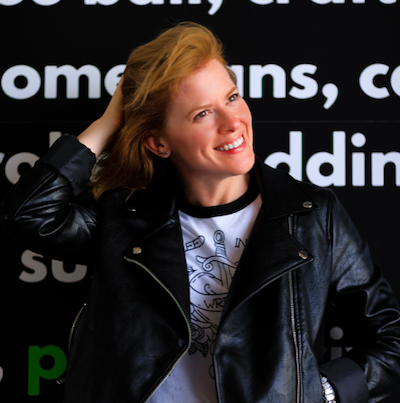
Carla Hoch is the award-winning blogger of FightWrite® and author of the Writer’s Digest book Fight Write: How to Write Believable Fight Scenes. She is a WDU instructor who regularly teaches on the craft of writing fight scenes, action, and violence as well as the mechanics of fighting for writers. Carla is a world champion jiujitsu player and has experience in almost a dozen fighting styles. She lives and trains outside Houston, Texas.