How to Read Your Work Aloud: Writer’s Digest 6th Annual Personal Essay Awards Winner
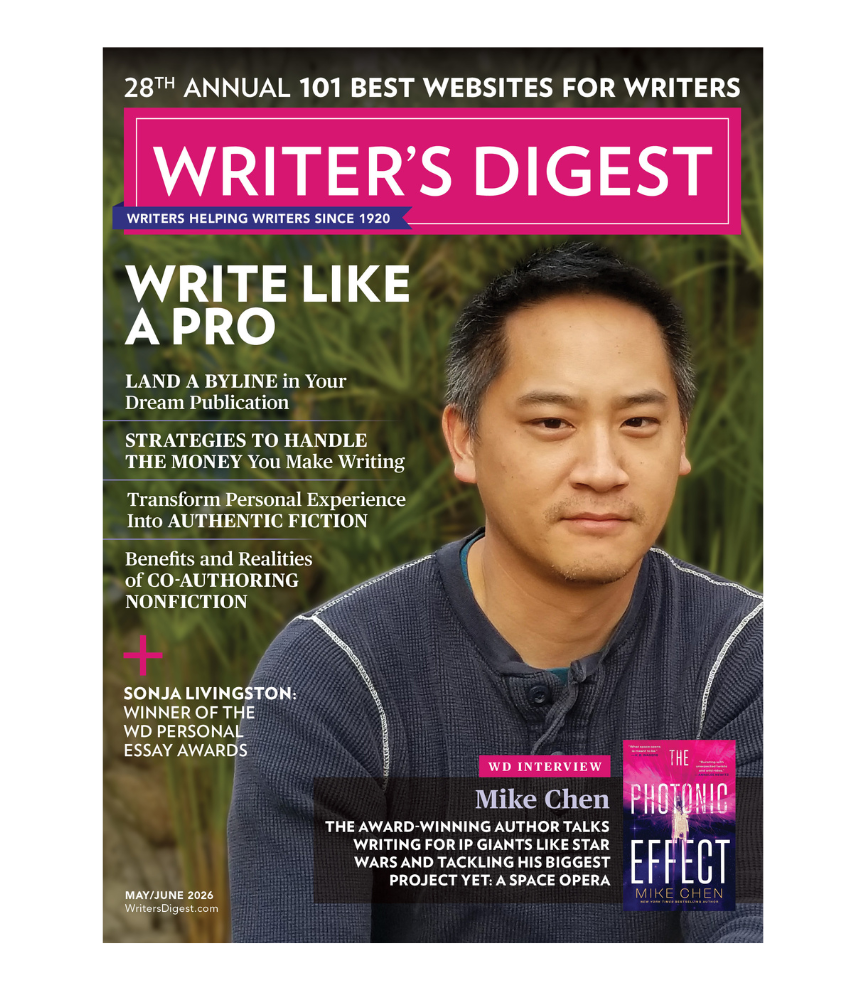
Congratulations to Sonja Livingston, Grand Prize winner of the 6th Annual Writer’s Digest Personal Essay Awards. Here’s her winning essay, “How to Read Your Work Aloud: A Ten Point List.”
How to Read Your Work Aloud: A Ten Point List
By Sonja Livingston
- Speak directly into the microphone. If you’re funny, tell a joke. If a psychic from Pittsburgh has ever warned you that no one gets your jokes and you are, in fact, not funny at all, open with a riveting image or a sucker punch. If all else fails, read your work as a numbered list.
- Forget the talent show at the sleepaway camp for underprivileged kids on the shores of Lake Ontario. Forget how you befriended the toughest girls before the bus left the city, the three of you, all chub and sass and puckered lip, rolling your eyes while your sister climbed trees and made boondoggles in the craft barn. Forget how you bragged you could hula and taught your friends to push their arms to one side while swaying their hips and circling their hands until you became a trio of exotic birds, so confident in your hula skills you volunteered to dance in Camp Troutburg’s annual talent show. Forget the curtains, the stage lights, the scratch of ukelele signaling time to begin. Forget the three of you freezing up there, not graceful creatures of the sky but objects of deep earth, unshelled and soft, bellies sloping into grass skirts, three sets of arms and legs stuck in place as a sea of campers solidified into a unified unblinking eye.
- Practice reading in front of a mirror. Consider recording yourself. If the confrontation of your own image flipped along the vertical axis is too much, read to your husband and cats who are listening even when their eyes appear closed.
- Wear something red. It’s true, the writer from Tuscaloosa leaned into her Alabama a tad too hard, stretching each syllable into silken taffy and calling you baby though you had her by five years. And while you both understood that she grew up largely intact, you played along as she one-upped you over whose childhood was harder—her matching you blow by blow when it came to whiskey-soaked grandmas and unpaid utility bills—and how long ago that was that you believed suffering could be quantified or parsed. Still, she brought the house down with her reading, that Tuscaloosa girl. “Wear something red,” she said when you asked her advice later at the bar. And when you said you didn’t own anything red, she stared, saucer-eyed, more disappointed than when you admitted not knowing the Flannery O’Connor story about the Bible salesman and the stolen leg. “Oh baby,” she said. “Not even a lipstick?”
- Make eye contact. Beware of toe tapping and the flailing of arms. Notice audience energy and adjust as needed. Some oppose revealing how many poems, pages or numbers appear in the list you’re about to read but what person in the seats doesn’t want to know what they’re in for?
- Believe every word you say. Fumbling that hula dance wasn’t about stage fright so much as the fact that, whether the three of you danced or froze at summer camp, you’d return to Conkey Avenue and Lamont Place where you’d no longer be hula dancers but girls whose mothers sent them to the corner store for milk and bread; girls who tugged shirts over budding bodies before pushing through groups of men swarming near the door; girls who paid for their mother’s milk and bread with food stamps. Listen: To dance like a bird, you must believe at least a little in your ability to be a bird. And while you did eventually come unstuck and managed to sway your hips and make your arms into palms, you never actually believed you could sprout wings.
- Do not indulge self-pity. Sure, the men blocking the entrance to the corner store were nothing but tooth and eye. And yes, food stamps were printed in pastel colors—cartoon money practically—and unlike with real dollars, you’d be given paper notes instead of actual change. But what does it matter whether the change came as nickels or scraps since you stole it anyway, buying Now-and-Laters and Chick-O-Sticks and lying when you got home, telling your mother, who spent her days spraying down surgical trays in the basement of Rochester General, that Louis Vasquez had raised his prices on bread and milk. Which is to say that there is no hurt ever done to you that you did not return to others, even in some small way.
- Trust the mural on the corner of Genesee Street. Think Good and It Will Be Good someone painted onto old brick. Forget women selling themselves on Sunday mornings and men pushing carts filled with bottles and cans. Everything’s redeemable, according to the mural. Think not of being frozen on that long-ago stage but of the songs you sang all the other days of camp. Rise and Shine. He’s Got the Whole World. This Little Light of Mine. Tell yourself the universe is here to support every endeavor you should undertake, that even the food stamps were pretty if you think about it right, all those shades of magenta, orange, and baby blue. Think Good and It Will be Good, the wall says. You have a rainbow in your pocket, hula girl.
- Do not go over your allotted time. If you’re given 15 minutes, use no more than 14.75. If you want to be mysterious, stop at 12. A fiction writer can break the rules and still manage to charm, poets will sometimes drift as a matter of vocation but even the best of goodwill is sucked out of the room when a memoirist goes on too long.
- Channel the deaf priest whose voice isn’t always clear but who becomes the word of God each and every Sunday. Channel Mala Barker at the nursing home who has lost her memory and repeats only a few words, one of them being blue. “Blue,”Mala says. “Blue.”One word, but an ocean too. Channel Jimmy Joe Sulli, the first of your friends to die and how much Jimmy loved to laugh. You can hear him laughing now, in fact, at how strange it all is—him beneath the ground at Holy Sepulchre and you standing in front of a bunch of people talking about hula dancing and food stamps. Remember how rare and lucky it is to be able to speak any words at all. Channel the graduate student who doesn’t even try to fit in—what a pain she is, that young woman with the razored hair and snarled lip—but her work cuts to the marrow, doesn’t it, when she says the thing no one wants to hear? Channel the old men in the café in the south of Spain, sitting so close their balding heads nearly touched. Brothers, lovers, friends—who knows? It was steaming that summer. The men sat beside each other eating ice cream. Or rather, one could no longer use his hands so the other fed him with a spoon. They threw back their heads after each bite, pecan faces broken open with pleasure, the two so radiant it was hard to tell which man ate ice cream and which man spooned it into the other’s mouth. In such moments, all distinction falls away. That is how to read your essay aloud.
About Sonja Livingston
Sonja Livingston is the author of four books of nonfiction, including the award-winning memoir, Ghostbread. She’s also the author of the craft workbook, 52 Snapshots: A Memoir Starter Kit.
Awards include a New York State Foundation for the Arts Fellowship, an Iowa Review Award, an Arts & Letters Prize, a VanderMey Prize and a Virginia Faulkner Award for Excellence, and an AWP Book Prize.
Sonja is an associate professor of creative writing at Virginia Commonwealth University and teaches in the postgraduate program at the Vermont College of Fine Arts. She divides her time between Richmond, Va. and Rochester, N.Y.
Moriah RichardAuthor
Since obtaining her MFA in fiction, Moriah Richard has worked with over 100 authors to help them achieve their publication dreams. As the managing editor of Writer’s Digest magazine, she spearheads the world-building column Building Better Worlds, a 2023 Eddie & Ozzie Award winner. She also runs the Flash Fiction February Challenge on the WD blog, encouraging writers to pen one microstory a day over the course of the month and share their work with other participants. As a reader, Moriah is most interested in horror, fantasy, and romance, although she will read just about anything with a great hook.
Learn more about Moriah's editorial services and writing classes on her personal website.
Related Stories