We Are Our Art, and Our Art Is Us
Author Zara Marielle discusses how, as writers, we are our art, and our art is us, and how what we write is never random.
“Write what you know.” You’ve seen this advice a million times, and you might also have seen others refute it. Personally, I live in the camp of “there are no rules, write whatever you want,” but there’s no denying that using what you know as a point of departure can be an interesting exercise that might lead you to unusual places. But whether you intend to place your story in a familiar setting or not, the truth is no author is a blank slate. We all bring pieces of ourselves to our work, regardless of intention.
Before we get too far into it, allow me to introduce myself. I’m Zara Marielle, author of The Café of Infinite Doors (Union Square & Co/ Hachette), an empowering contemporary fantasy novel coming out in April of 2026. The Café of Infinite Doors tells the story of Marceline, a trapped housewife who secretly takes a job in a magical café, only to find herself entangled in a deadly ancient rivalry between two Scottish goddesses. The narrative takes place partially in modern San Francisco, partially in mythological Scotland, and partially in a café outside of time and space. Despite all these fantastical elements, much of the book comes from material mined from my own life.
The expression “every fiber of my being”, often used in melodramatic romantic declarations, implies that humans are made up of metaphorical threads. (Assuming its early authors weren’t referring to dietary fiber, which would be weird.) I personally never liked this cliché idiom, but in this case, I find it interesting: If each of your longings and experiences and emotions is a thread, then any art that comes out of you must be woven from that same source material. We cannot detach from our identities when we create. Have you ever exclaimed “I wish I’d written that!” after reading a particularly well-crafted piece? Well, you couldn’t have. That piece can only exist because of who the author is as a person. We are our art, and our art is us.
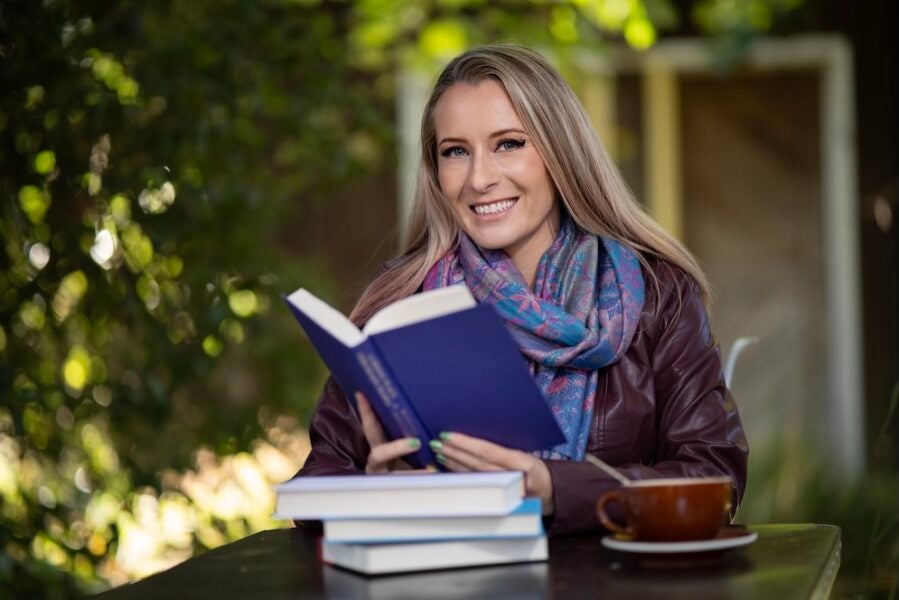
I always knew I’d write something set in a café. I grew up above my parents' coffeehouse, in our small Northern California town. Café life is familiar and comforting to me. In fact, I’m sitting in a café right now as I’m writing this. But because I’m a fantasy gal, the fictional café in my mind was never going to be an exact replica of the source material. Every idea I have involves a speculative edge, and though I read widely, a large portion of what I enjoy reading involves magic. It was only natural that I should combine two things I enjoy: Cafés and magic.
I should give my parents credit for the inspiration. Despite being nestled in the redwoods, their coffeehouse has a distinctly old European vibe, complete with international newspapers, medieval musical instruments hanging on the walls, a fireplace, and a resident cat named Gladys. Everything is wooden. Years before I was born, my mom hand-stenciled the decorations on the shutters herself. When I started dreaming up the nameless café in my book, similar details began to filter in, unbidden.
My fictional café also features newspapers, only these ones are a tad more unreliable—the words change as soon as you blink. Instead of old musical instruments, tribal masks hang above the mantle, emoting in response to the shenanigans of patrons and staff. Tiny tea goblins sneak into teapots to nap. If you sniff a particular brick in the wall, your favorite nostalgic scent comes wafting out. And while there’s no café cat, the rafters are filled with birds of every species roosting together and causing a cacophony that you soon learn to filter out. But what’s special about the café in my book isn’t the whimsical decor, but rather what it means to its human clientele.
When I began plotting The Café of Infinite Doors, I’d only recently recovered from a rather brutal episode of my life. Like my protagonist, Marceline, I’d been in a very toxic relationship, which had led to me leaving a job I’d loved. I’d also learned that my mother had Alzheimer’s, and was newly grieving the person she used to be. (If you read my book, you’ll notice motherhood popping up in all sorts of unexpected ways that surprised even me.) Though I’d found a new job and met the man who would later become my husband, that new job soon shuttered forever, thanks to the pandemic. And as for Mr. Future Husband? Our relationship had just shifted into long-distance. All of this to say that when lockdown rolled around, I had plenty of solitude and time to reflect on what I’d been through. And of course, I also had time to write.
Before I knew it, these events I’d so recently experienced began to infiltrate the book I was plotting. (Isn’t writing just magical like that? Oftentimes I don’t even realize I’m grappling with a certain theme in my personal life until I find it leaking into my latest work in progress!) Thus, the café was born. It became a venue for lost souls from all over the world, searching for a place to belong. Searching for companionship, searching for understanding, searching for a sense of empowerment.
The café in my book isn’t open to any old Joe-Schmoe with a dollar to spend. In fact, they don’t accept money at all. It isn’t actually a business, but rather a place of respite for those who need it. It can be accessed through infinite portals around the world, and these portals are activated by need and presided over by whichever bird is most local to the seeker’s homeland. To pull a direct quote from chapter 23 of the book,
Without ever leaving the confines of those walls, Lucretia had managed
to gather her flock. A flock dependent on neither geography nor
ancestry, as it might have been in the days of her mother’s rule. No— this
flock welcomed anyone who found it within their heart to follow a bird
through a doorway.
I could ramble at length about all the ways my novel grew from the soil of my own identity and life experiences. The inspiration for the ancient Scotland chapters came directly from my time studying at the University of Edinburgh. Likewise, my fictional café caters to patrons from every country because internationalism has always been an important part of my life. I grew up going back and forth between the US and France, have lived in six countries, and work in the ESL world for my day-job. It isn’t surprising that I find so much inspiration and delight in interacting with people from different cultures.
In essence, what you write is never random. Every novel, short story, or piece of flash fiction is a tapestry woven from the author’s longings and experiences and dreams, and for that reason, a work is inextricably tied to its author. Which makes publishing a piece for public consumption a terribly vulnerable experience. Anyone with a sense of subtext and enough interest can read a novel and dissect what makes the author tick. For the author, this can be both terrifying and cathartic.
As a debut author, I’ve been reading a lot of soon-to-be-published works by my fellow 2026 debuts. I especially love doing this when I’ve spoken to the author in person, because it gives me an insight into who that person truly is, and what’s important to them. That’s why it’s so beautiful to read a book and see your own experience reflected back to you. You may never have met the author, but suddenly you’re holding irrefutable proof of your shared humanity. You feel seen, perhaps like never before. If that isn’t magic, I don’t know what is. So keep mining your soul for material, because the more of it seeps into your work, the more your truth will resound, weaving through the words and sentences and paragraphs. Be brave and be real, and share your truth with your readers. After all, we are all interwoven by our shared humanity. Learning this lesson might just be the thing that saves us all.
Check out Zara Marielle's The Café of Infinite Doors here:
(WD uses affiliate links)