Teaming Up as a Father-Son Author Collaboration
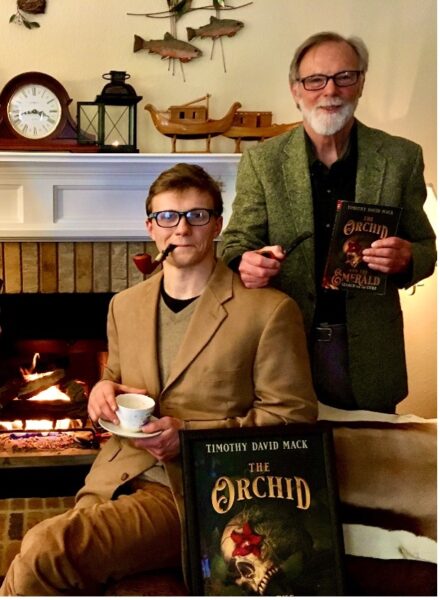
Teaming up as a father-son author collaboration, Timothy David Mack (yes, both of them) discuss how they started their journey together.
When people hear you’ve written a book with your Dad, they give you a look. It’s a questioning look. One of the questions is, broadly, Why? Or, specifically, what judge ordered you to do that? Was it for speeding through a school zone?
To answer your questions, No. It wasn’t court-ordered. Personally, writing a book was the fulfillment of a wish I’d had since childhood, and seeing it published with my Dad was like the ironic twist from having that wish granted by a monkey’s paw: ‘You will be a published author… but you must attend every promotional event with your Dad.’
So how did that happen?
Out of fairness to my Dad, I’ve included him in telling you the story of our partnership as it’s the only way we can make sense of it ourselves: in fragments, out of order, each of us remembering different things with different levels of accuracy. In short, an oral history.
My father will claim his version is more reliable. I'll let you draw your own conclusions.
There's a third voice in all of this, even if she's only present in the telling. My Mom, Sheila, was the reason the books got written, and the reason they're any fun to read. She was our sounding board while we were working through the story, and she had one rule—but we’ll get to that.
We are David McNeill and Kevin McNeill. We write under the pen name Timothy David Mack. This is, as best we can remember it, how that happened.
***
Kevin: I only started writing fiction at my wife’s prompting. She knew I’d wanted to write my whole life. I suspect she also knew that I needed a distraction. Sheila had been diagnosed with Stage IV breast cancer. She was also a nurse, and I think she knew what lay ahead of us when she made that suggestion.
David: My Mom hated being called “sick.” As if that meant she should drape herself in blankets and retire to a four-poster bed, or smile weakly and drink broth for the rest of her life. She took her illness and moved it so far outside of herself that it always looked to us like something tiny in the distance.
Kevin: But I hesitated. I didn’t want to write something that had already been written. Having been a prolific reader my entire life only made the task seem more daunting.
David: One thing to know about my Dad: Kevin McNeill loves to tell stories. To anyone who will listen.
Kevin: The problem was I couldn’t settle on a topic. It wasn’t until a visit to the Biltmore Estate in North Carolina that an idea presented itself—again, at Sheila’s encouragement! After a memorable afternoon spent wandering in the orchidarium, Sheila suggested that I write a book about the hunters who’d furnished the original plants in the 19th century.
David: I never asked my Dad, ‘Why orchid hunters.’ Maybe I assumed all dads were interested in orchids and the men who hunted them; maybe I preferred not to know… What I did know was that he wasn’t interested in carpentry or collecting shot glasses.
Kevin: Once the seed was planted (so to speak), I threw myself into researching and writing the book. After some arm twisting, I even enlisted our son David as my editor and eventual co-author.
David: I was at the top of his list of editors, seeing how I was available, and in the kitchen. I'd graduated with a degree in English, which basically meant I was back at home, in my childhood bedroom, and going to work at the same YMCA where I’d been a lifeguard when I was 15. In the end, negotiations were short.
Kevin: For our first novel we imagined a British soldier named William Gunn, who wanted nothing more than a quiet life after returning home from the Napoleonic wars.
David: Before he wrote one word of the story, my dad spent two years researching the geography, the cities, the cultures, and the events occurring in Colombia, Brazil, and Ecuador from 1800 to 1850. I spent the next three years telling him to move these facts out of the story and into the footnotes (before finally telling him to delete the footnotes). Thankfully, enough amazing historical detail has survived in spite of my fanciful revisions that you might actually stand to learn something if you read it. This is a compelling pitch for some people.
Kevin: We worked on the first book for five years. We went through five revisions and over 1,000 pages written. By the end it was difficult for either one of us to feel like we completely owned the final product. I think this was to the book's benefit. Neither of us was overly attached to our own point of view, or vision for what the book “should be." That’s difficult to find in partnerships.
David: Dad wrote, I edited, and Mom listened.
Kevin: Of the three of us, her part was the most important. As far as I could tell, our story was only working if she was laughing. You could see her spirits lift when she heard her suggestions take shape on the page. She was our only reader, and she had only one rule: it had to be fun.
David: There are sea battles, revolutions, lost cities hidden in the jungle, and a mythical black orchid that can cure any illness. But we were having trouble with the very end of the story.
Kevin: Not long before she passed, Sheila helped us find the answer. At the end of the novel, Nate, William’s guide and (eventual) friend, is in jail facing execution. It’s there that he realizes his only legacy will be the memories he’s left behind. He wonders in how many he chose to serve himself, when he might have had the chance to fight for others. That was when Sheila suggested the perfect line to end the book.
Kevin: Sheila wasn’t there when our agent, Mel Berger, called to tell us he’d read our manuscript, or when he found a publisher. But we know she wouldn’t have been surprised.
David: Sheila grew up on a dairy farm in Ireland with 11 brothers and sisters. At school, she was elected Head Girl and given a room to herself (which she in turn gave to any girl who wanted to sneak a cigarette). She tried out for the role of old crone in the school play, because it looked like more fun than the lead. She watched airplanes cross the sky and dreamed of traveling. When she graduated from Nursing College, she got her chance, leaving home to work in Bangladesh for an aid organization, before moving to Israel. That was where she met Kevin. And, on a vacation to the Biltmore Estate in North Carolina, she suggested to my Dad that he be the one to write a book about orchid hunters, those crazy adventurers who traveled to dangerous lands and left with something common, which somehow became a treasure when it was transplanted thousands of miles from home. I wish the whole world had gotten the chance to know my Mom.
***
Thinking back on the story of how our first book was written, I’m reminded of just how powerful a force stubbornness can be. It matters more than intelligence, which doubts itself, or strength, which weakens, or hope, which is lost as easily as it’s found.
Sheila was the most stubborn person I’ve ever known. She found a way to carry on, in the memories of those who knew her (which includes you too, now), and in the spirit of our books. She would have one suggestion, if you decide to sit down and read our stories: Have fun.
Check out Timothy David Mack's All the Tea in China here:
(WD uses affiliate links)