

How Birding Can Train a Writer’s Attention
Author and birder Ragan Sutterfield explains how birding can help writers, especially through the development of attention.
“Attention,” wrote the philosopher Simone Weil, “is the rarest and purest form of generosity.” It is a gift we give, wherever our senses settle. To be seen, to be heard—what longing is deeper? And yet, attention is rare because it is difficult.
Weil was writing in the middle of the 20th century, a time when the distractions of the digital had not been unleashed. To attend to another, to words, to the world—it has only become harder. Still, as any writing is a testament, it is not impossible.
Writing is an art of attention. One of the thrills of a sharply written scene or a great line, whatever the genre, is the way it draws the mind to a mundane point and opens its surprising significance. The sideways sheen of a bright dawn, the smoky twist of a kettle’s steam, or an oak leaf, cut at the edge like a child’s zig-zag scissors, by the mandible of a caterpillar.
If we want to write well, we must learn to pay attention to a world more varied and wonderful than we notice at first glance. And while writing is a practice of attention, it helps to have another way in, a parallel practice that can lend more texture to our texts.
What practices can help us deepen our attention? Weil, for her part, recommends studying math. Good for anyone who takes that path, but getting math behind me was one of the best parts of my freshman year of college. I imagine many a writerly type would think the same. Instead, to train my attention, I’ve chosen a more colorful and lively practice—birding.
They live on every continent in every context. Land or sky, running rivers or swelling seas—birds are everywhere in a dizzy variety. 10,000 species is the usual estimate ornithologists give for the number of unique birds in the world, though there may well be more. From the tiny spark of the bumblebee hummingbird to the sun-shading span of a California Condor, birds are animals that can easily catch the eye or ear. And yet, as colorful and charismatic as they are, birds can be surprisingly elusive.
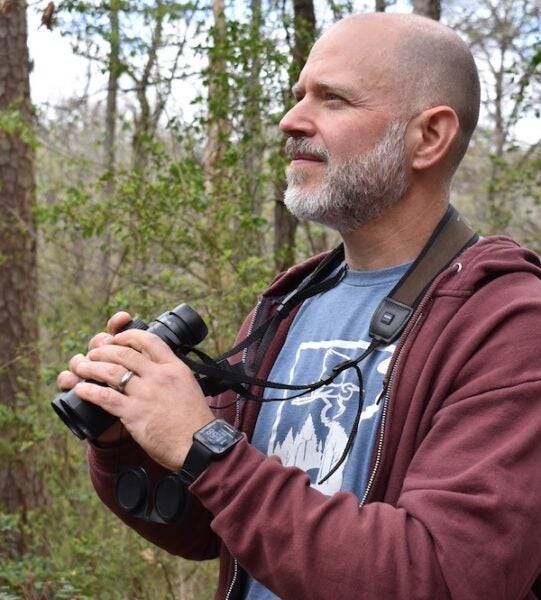
Birding is the art of tuning in. With eyes watchful and ears attentive, birders can sense the landscape and find the creatures hidden in plain sight. Whether it’s an active pursuit over an afternoon with binoculars in hand, tallying the birds seen or heard on the eBird app, or a casual awareness throughout the day, birding can help reveal the varied world always around us. In this way, it is a lot like good writing. Like reading a good book, we leave a time birding with a renewed perspective.
Try this as an exercise. Go outside and find a place as free as possible from the noise of machines, traffic, and the like. Sit for 10 minutes and see how many bird species you can see or hear. You don’t have to know the names of each. Just notice the differences. Now, download the Merlin app from the Cornell Lab of Ornithology, which listens in on the local landscape and identifies the birds it hears. I’d be surprised if there weren’t at least five different species, maybe more, swirling around you at any given moment. How many did you hear? What did Merlin reveal about the hidden presences of that place?
Merlin can be a helpful way into birding, but I also recommend a good field guide. Books like The Sibley Guide to Birds can be a helpful introduction to the range of species. Flipping through the book, looking at the maps, comparing the various families is an exercise in attention all its own. It is like perusing a dictionary—a time of absorbing images and shapes, patterns, and plumages that will come in use when the moment of encounter comes.
Birds can also help train our attention to our places. Birds are widely different according to geography and setting. Blindfold a good birder, drop them in a place for half an hour, and they would likely be able to tell you the general location, and whether the habitat was a forest or marsh, a field or ocean, or a suburban neighborhood. Birds can reveal a place like no other living creature.
Since birds are so tied to particular places, they can be useful for setting a scene. Birders find many movies annoying because the bird sounds used in the background often reveal where the film was shot rather than where the scene is actually set. A writer who uses representative birds for scene-setting will not only thrill birders but also offer readers an important texture in the landscape. Even if unconscious, such details help readers enter the place.
Birding can be as casual or serious as one wants to make it. However seriously a writer wants to take it, beginning to pay attention to birds, and what they reveal about the world around us, will deepen our connection to the layers of life in any given place. To take that attention and bring it back to the words we write will be an act of generosity in its purest form.
Check out Ragan Sutterfield's Watch and Wonder here:
(WD uses affiliate links.)