A Conversation With Marion Winik on Memoir, Audiobooks, and More
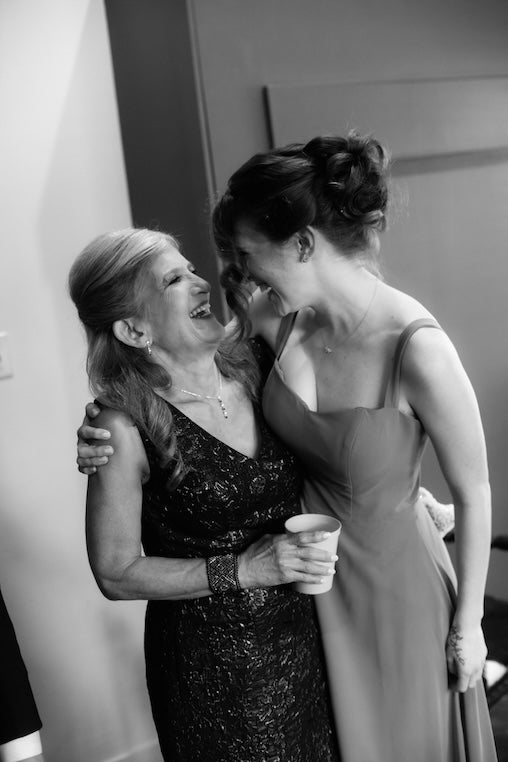
Journalist Jane Winik Sartwell has a conversation with her mother Marion Winik about her memoir, First Comes Love.
Marion Winik's 1996 memoir, First Comes Love, is the shocking, magical, and tragic story of her first marriage to a terminally ill gay figure skater turned hair dresser. The drug use, the sexcapades, the violence, the magnitude of the loss, her sheer strength: The story knocked the wind out of me over and over. I don't think it's my bias talking when I say that my mother has written one of the most complex, eyebrow-raising, and absorbing love affairs in print.
This month, Penguin Random House is publishing a 30th-anniversary edition, along with a newly recorded audiobook. Though I've come to terms with a lot of what's in the book, I still have questions. Not least among them: Mom, are you f****ng crazy?! Now, I have a chance to ask her.
When reading this book aloud all these years later, how close did you feel to the you who narrates the book, especially in those early days when you first got down to New Orleans?
It was a near-psychedelic experience. It was as if the 67-year-old me was having a meeting with the 27-year-old me, and I was really a very different person. I was so passionate and so reckless, so driven by hormones, so full of beans. There really is such a thing as the aging process. I’m a lot more mature and thoughtful and less self-involved than I used to be. I had originally written the book with a sense of humor, despite the heaviness of the subject matter. But when I read it, I kept thinking: ‘Oh my god, now what is she doing?’ That comes through in the audiobook: There is occasionally an extra layer of irony.
You review audiobooks for many major magazines. Did that impact your approach to recording this one? Any pet peeves you wanted to avoid, or things you wanted to emulate?
I always feel that unless the writer has some sort of impediment or condition that makes it impossible for them to read the book, all memoirs benefit tremendously by being read by their authors. There are beautiful audiobook narrators, even actresses like Meryl Streep that do remarkable audiobooks. But when memoirs are read by the author, they instantly vault into a special category. I was empowered by the idea that it would be extra special for people to hear me say this. There’s some very intimate revelations and real vulnerability in First Comes Love: my drug use, my crazy decisions, my sexuality. It can’t help but be more powerful for me to tell you in my voice.
At the very end, you say "I know [Tony] would want me to get this right." What do you think Tony would think of the way you portrayed him in the book? There's so much good, but there's so much bad. Were you afraid of writing it all down then? How about revisiting it aloud now?
I would never have even published it if I didn’t believe Tony would support it. He was alive for the first couple years I was working on the book, and he helped me a lot. He knew me. He was part of my life as a writer since it first started. He could have had no doubt that I would tell the full story. I think he would be very glad that I’m so hard on myself. I tried to show that I was not just some innocent victim of his bad behavior. Some of the things that happened to him, and happened between us, are just plain terrible and unforgivable. The purpose of the book is to give an honest picture of what happened. Without that honesty, it's just not as valuable to people that are reading it, looking for some kind of inspiration or energy they can relate to and apply to their own problems.
One moment that stuck out to me was when you told the boys how their father really died. Why did you think it was necessary?
Family secrets are one of the most dangerous commodities there is. If somebody finds out they’ve been lied to for 30 years about who they are or who people closest to them are, it creates distance and problems and estrangement and pain that is just wrong. I never wanted that for my kids. I didn’t give them every gory detail from day one. But it’s such a big mistake to lie to kids. Growing up, I didn’t have a family where there were secrets. I knew some dubious things about the older generation, but I liked knowing the complexity of our story. I knew about the dangers of family secrets from reading fiction and memoir. As a reader, I’ve seen what can happen with these lies. It’s a life lesson I’ve learned from being a reader. I didn’t want that in my life. There are some debates about my character, especially in the Goodreads reviews section of the book, but no one can think that I’m not an honest person.
You told me the other week you've never written about anything so well as about your dad. Why do you think that’s true?
This is true for so many writers. As a writing teacher, I see it all the time. Writing about your parents is your most golden material, even if it's rough. That’s the cauldron of your identity. It’s so important to your whole worldview and understanding of yourself. It’s the best, most powerful, most emotional material you have, whether you use it in fiction or nonfiction or poetry. I’ve always been amazed how true this is, because it's not like I’m a novelist and I can keep making up different characters that are sort of like my father. I’ve literally written about my exact same father in four or five different books, and somehow they each have their own powerfulness and sparkle. One of them even starts: How many times can you write about your father? It was a never-ending source. Your father may not change, because in my case he’s dead now, but you keep changing, and as you change your relationship to the memories changes. My father is such a hero and a character to me. Everything that I have from him is really special to me, and a part of myself that I always want to honor and bring out.
You talk in the new introduction about how there were things in the book that weren't true, but that were true for you at the time. Given your years of teaching memoir, do you see this as an inherent part of the art, or a mistake to be avoided as much as possible?
It’s both. It can’t be avoided. I was just talking to Amy Bloom, who has written a beautiful memoir about helping her husband with an assisted suicide when he had early onset Alzheimer’s. She was so clear: you can only tell the story you know. It’s very likely that other people won’t think that this is the story. It’s just the condition of memoir. You don’t see what other people see. You can only see what you see. You may have limits to what you can know. I thought that Tony and I had a monogamous marriage for eight years. It turned out that that wasn’t true, but it was an integral part of how I conducted my life at the time. Even though it was not true, it was real.
Check out Marion Winik's First Comes Love here:
(WD uses affiliate links)