Writing Muslim Mavericks: Lessons From Maysoon Zayid on Dreams, Disability, and Representation
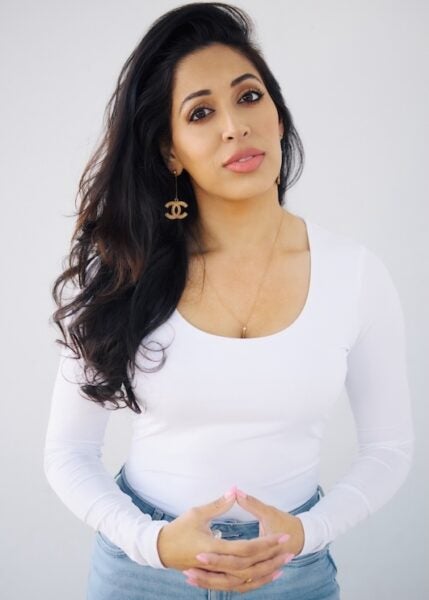
Award-winning journalist Seema Yasmin writes about the lessons she learned from Maysoon Zayid on dreams, disability, and representation.
The opening lines in the first book of the Muslim Mavericks biographical series ask young readers to imagine what they would be in their wildest dreams. An astronaut jetting to a faraway planet? A swimmer soaring through the waves with dolphins? A pilot gliding high in the sky alongside eagles?
When Maysoon Zayid, the subject of Muslim Mavericks, Volume I, fact-checked my manuscript, I wasn’t prepared for her feedback. “Those activities are all physical,” Maysoon said, pointing to the opening lines. “Did you notice that?”
I hadn’t. I had expected Maysoon to offer corrections about the details of her childhood in New Jersey, her relationship with her three sisters, or the physical therapy exercises she did before school each day to manage her cerebral palsy. I wasn’t prepared for Maysoon to challenge the way I talked about dreams.
“Yeah, I don’t dream about that stuff,” she told me.
Through interviews with Maysoon and research on cerebral palsy, I had worked hard to portray the disability accurately and in a way that a middle-grade reader would understand. She told me she was happy with how the book captured her daily life and how it reflected the variety of experiences among people living with CP. But as a non-disabled woman writing about a disabled woman, I had not thought deeply enough about how disability might shape the way a young person imagines their future.
Maysoon explained that as a child she did dream of being a dancer on Broadway, but she also dreamed of making a groundbreaking scientific discovery, or changing the world through her words. She challenged me to think more expansively—and less physically—about what dreams can look like.
That conversation stayed with me. It forced me to reckon with my own unconscious biases—ones that had seeped into my writing despite my best intentions. As a doctor, I understand the biology of cerebral palsy. As a science journalist, I have the tools to translate complex ideas into stories that resonate with middle-grade readers. But as someone who grew up steeped in a culture that privileges certain kinds of bodies and abilities, I was still unlearning ableism that medical training had, in many ways, reinforced.
There’s an ongoing debate in publishing about who gets to tell which stories—who has the “right” to write outside their lived experience. I’ve thought deeply about that question while working on Muslim Mavericks. As a fan of Maysoon Zayid’s comedy and writing, I wanted the first book in the series to center on a Palestinian, Muslim, disabled girl from New Jersey—a story that rarely gets told in children’s literature. Representation isn’t just about ticking boxes; it’s about expanding empathy, imagination, and belonging for every kind of reader.
Maysoon has long been an outspoken advocate for disability representation in the arts. She’s called out the lack of disabled characters in television, film, and books—an omission that shapes how children see themselves and others. The statistics are staggering: only 3.4 percent of children’s books feature a disabled main character, according to a 2019 study by the Cooperative Children’s Book Center. That’s a shocking gap when more than 7 million disabled students are enrolled in U.S. K–12 schools—a number that has nearly doubled since the 1970s. One in six American children between the ages of 3 and 17 has at least one developmental disability, according to the Centers for Disease Control and Prevention.
When children with disabilities don’t see themselves reflected in stories, the message they receive—intentionally or not—is that their lives and dreams don’t belong in the realm of imagination. Stories are where we first learn what’s possible. If we exclude certain bodies or minds from that space, we also exclude their possibilities.
Writing Muslim Mavericks has reminded me that stories can heal, but only when they tell the truth—about joy, struggle, and complexity. Maysoon’s story is not one of overcoming disability; it’s about embracing it as part of her brilliance and resilience. It’s about humor, art, faith, and a refusal to shrink herself to fit others’ expectations.
When I think back to those opening lines—the astronaut, the swimmer, the pilot—I now realize how narrow my own imagination was. Dreams aren’t limited to what the body can do; they thrive in what the mind can imagine, create, and transform.
The Muslim Mavericks series began as a project to highlight Muslim trailblazers whose stories defy stereotypes. But it’s also become a mirror for me—a reminder to check my assumptions, expand my empathy, and approach every story, every person, with humility. Writing about Maysoon Zayid didn’t just make me a better author. It made me a better listener, a better writer, and—perhaps most importantly—a better dreamer.
Check out Seema Yasmin's Maysoon Zayid: The Girl Who Can Can here:
(WD uses affiliate links)