

Why I Chose to Write an Autobiographical Novel Instead of a Memoir
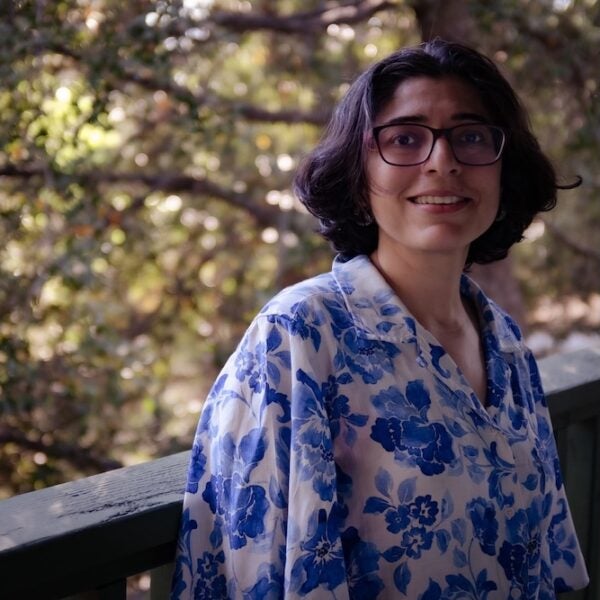
Author Shivani Malik shares why she chose to write an autobiographical novel instead of a memoir while processing grief.
As soon as I typed the sentence, “I think the universe punished me for wanting too much,” I knew I had to delete it. Immediately. I felt my scientific training recoil—the statement had no logic. But grief doesn’t work that way. It contradicts itself; does not follow reason. That sentence—so irrational and absurd—was the closest I could come to the truth of how I felt.
My cognitive dissonance had strong roots: I had spent almost a decade studying the esoteric, molecular processes of cells, first as a graduate, later as a postdoctoral student. I researched the cellular checks and balances that maintain our genomic integrity—the disastrous consequences when these DNA damage repair mechanisms fail, cancer being only one of them. I worked on therapeutic strategies to rescue cells that lost their most fundamental mechanism of survival: the ability to keep the genetic blueprint intact. While I excelled at dissecting the molecular chaos of a tumor cell, I could not even name what I was feeling. What was that heaviness that had taken a permanent residence inside my chest? It had been there since I had lost my mother three years ago.
When at age 24, I decided to fly 3,000 miles away from my native India to study in the US, I came with one self-imposed expectation: to prove I was worthy, and I had a roadmap for it. I would achieve the highest academic degree, be completely self-sufficient (financially and emotionally), and prove to be a competent alien of this foreign land.
This straightforward equation to achieve a life worth living proved woefully inadequate when my mother died suddenly at age 53. Where did I go wrong? I was doing everything according to a well-thought-out logic. Why was my mother taken away from me? That single, unanswerable question eroded the foundations of my carefully constructed, rational life, leaving me hollowed out.
Given my professional training, which emphasized self-sufficiency and the ability to solve every problem myself, sharing this confusion with anyone was simply beyond my capacity at the time. I could not bring myself to voice to my PhD advisor that the best dissertation award, which he hoped my thesis would win, suddenly held no meaning to me. It would not bring my mother back. I knew it was irrational to connect a professional accolade with a deep, personal loss. And didn’t I always dream of that award? So, I kept silent, listening as he laid out the points in his nomination letter in loud, excited tones, standing in the middle of the lab while I sat on the cold, metal lab stool, my eyes flitting between his sparkling dark eyes and the white wall behind him.
When I graduated and moved from the sleepy midwestern town to San Francisco, I imagined that these conflicting thoughts would quiet in the bustle of a new city and the sparkle of prestigious hallways of the cancer center of Stanford and UCSF. But the heaviness in my chest grew until two years into my postdoc, my body broke down and I came down with shingles. The urgent care doctor next to the university told me to take a week off to rest. As I lay in bed in my apartment, observing the odd patterns the weak winter sunlight made on the black and white rug, tears began to roll down my face. I closed my eyes and let myself think of my mother, deeply, for the first time in five years since she passed. It may have been a few minutes or an hour but, when I opened my eyes, the patterns had dissolved into the black of the rug.
I got up and picked up the lined notebook I kept next to my bed. Instead of jotting down my next experiment, I began writing every detail of the day my American visa was granted. My mother had been so excited; her daughter was going to the US on full scholarship to become a scientist. I remembered the moisture in her black, kohl-lined eyes. She was proud of me, she had said. I continued writing, half of my words smeared by my tears. I filled 10 pages of the notebook simply repeating how sad I was to lose her.
Writing, therefore, became my mechanism to make sense of my loss. Not only did it allow me to put into words the thoughts and emotions I had been hiding from my rationalizing mind—I could also escape the vulnerability of having to speak them aloud.
As I continued writing, my focus began to broaden. I was no longer the naive 23-year-old who took the first international flight from India to Illinois; I was 33. The sheer pain gave way to reflective questions that, at first glance, seemed unrelated but were, in fact, profoundly intertwined with my disillusionment. Why did I commit myself to such a difficult, highly competitive area of study? Was this ambition truly mine, or was it a desperate attempt to prove my worth? Writing created a sacred, enclosed space to explore the life choices that had complicated my grief and shaped my reality in unforeseen ways.
All of this stemmed from how honest I was about how much I missed my mother. I had been writing every day for a month before bedtime and letting out that pain felt comforting and liberating—like the first drop of monsoon after the intense summer. However, I felt the first inkling of self-judgement when I wrote how I was in denial throughout the 34-plus-hour flight ride from Chicago to Bombay. Until I saw her dead body in a glass body freezer in the living room of my home in India, I would not believe that Mummy was dead. My rational brain accosted me: How could I be in such denial? Papa had told me she suffered a heart attack and was dead. He told me I needed to fly in as quickly as possible for her cremation and to observe the last rites according to Hindu beliefs. How could I tell myself she would be magically alive when I arrived home—that my love would make her alive again? That was nonsense.
My rational brain also challenged me to justify my illogical anger: I was furious at the universe for punishing me for my professional drive—for wanting too much. That’s when I realized I needed a way to confront the emotional truth—the truth of how I felt—without being restricted by my own self-concept as a rational scientist.
Two months into writing about my mother, I dreamed of myself as a character—Shani, a nickname my mother and sister used when I was little. The character was free to inhabit the deepest emotions without the need for justification. She was not me, after all; she was fictional.
Like me, the fictional protagonist Shani had come to the US to pursue higher education. She also loved her mother a lot. Through her, I could safely admit to feelings I had previously dismissed as "ridiculous," such as the inexplicable, gnawing sense of loss of home that persisted even when I was physically inside my own cozy apartment, a bonsai plant on the glass coffee table and an abstract green and white painting adorning the wall behind a leather couch placed at a perfect distance from a flatscreen TV. When I wrote through this fictional character, I could articulate that losing my mother felt akin to losing my home, even though I had already been living thousands of miles away.
When I was writing a memoir, I fact-checked the validity of that feeling, but now my fictional proxy could simply feel it, allowing the reader to experience the pure, irrational weight of the loss alongside her. It became reasonable for the protagonist to feel she did not belong in the academic halls of a top university even though she had a PhD with several papers. Not only did fiction free me from the legitimate anxiety of real-world repercussions from past managers, colleagues, and the academic community I still inhabited, it also allowed me to have a chink in the iron armor. Through Shani, I could be vulnerable; I could let go of the expectation that I always projected of that of a competent and secure professional scientist.
By utilizing the fictional lens, I realized I could immerse readers more deeply into my paradoxical feelings than I could through memoir. I could share the personal nuances of my unique immigrant and academic experience while connecting with the universality of navigating profound loss and internal chaos. I was relieved that I no longer felt bound by the accuracy of events. Since I take accuracy very seriously as a scientist, having to look straight into readers' eyes and say this is how it happened and this is how I felt was not something I could take on at the time. Crucially, fiction gave me the necessary distance to observe myself deeply and honestly. To achieve true authenticity, I realized I needed to step outside of myself. Fiction offered me that space.
For any writer struggling to be honest about their own history, using a fictional proxy might give them a vantage point that reveals what remains hidden at the surface of their self-understanding. It certainly did that for me.
Check out Shivani Malik's The Sky Is Different Here here:
(WD uses affiliate links)