
Why Doctors Write Fiction: Medicine Runs on Stories—and Sometimes Only a Story Can Tell the Truth
Author and medical doctor Shantanu Rai shares why it makes sense for doctors to write fiction to help bring change.
Whenever I tell someone I wrote a novel, I get the same reaction: eyebrows up, head tilted, a soft, “Really?”
On some level, it makes plenty of sense that people are surprised. I’m a medical doctor. How did I possibly find the time? But the more I’ve paid attention to people’s reactions, the more I’ve realized the surprise isn’t really about time. It’s about the idea that doctors, of all people, might write stories. To most people, doctors live in the realm of science and technology—MRIs, blood tests, pharmaceuticals. Story belongs to artists, not clinicians.
But inside medicine, story is not decoration; it is the core tool.
We literally take histories. And when we call a specialist, what they often ask is not, “Send me the chart.” They ask: “Tell me the story.”
The story is how we turn scattered facts into meaning: a character (a patient), context (a life), conflict (a symptom), a plot (a progression), an ending we are trying to change.
Diagnosis itself is an anthology—patterns passed from one human to another, refined through repetition. Even policy can be shaped by story. Dialysis became a Medicare benefit in part because a patient dialyzed himself in front of Congress—showing, not telling, what access could mean for a life.
So in one sense, it’s inevitable that some doctors write.
But there’s another reason clinicians increasingly need fiction—and it has less to do with craft than with survival.
In modern healthcare, many clinicians work for large systems: employers with marketing teams, compliance teams, and legal departments. During the pandemic, that power imbalance became unmistakable. Nurses and physicians who spoke publicly about unsafe conditions—inadequate PPE, overwhelmed units, staffing crises—sometimes faced discipline or termination. A system willing to punish transparency teaches clinicians a lesson: Tell the truth, and you may lose your job.
That reality corrodes medicine. It also shapes what clinicians can safely say in public. You can write an academic paper. You can give a sanitized interview. You can speak in abstractions. But the lived truth—what it feels like when a system forces you to choose between a patient and a metric—is harder to tell with your name attached.
Fiction offers an outlet that is both artistic and protective.
It protects patients, because it allows a writer to transform identifying details and composite experiences. It protects clinicians, because it can provide a layer of anonymity in an increasingly corporatized landscape where candor can carry consequences. And it can preserve the emotional truth of an experience—not merely what happened, but what it did to the people living inside it.
That emotional truth is what many readers are hungry for, whether they know it or not. Witness the popularity of The Pitt, as realistic and damning a portrayal of what it’s really like to work in an ER than any medical show ever made. But by and large, the public sees medicine through bills, headlines, and a few dramatic moments in urgent care. What they rarely see is the moral residue: the quiet heartbreak clinicians carry home; the helplessness that accumulates when the “right” care exists but is financially out of reach; the feeling of being responsible for outcomes you can’t fully control.
When done well, fiction can illuminate those forces without turning into a manifesto. It can do what journalism sometimes can’t and what policy language often won’t: Make the reader feel the system from the inside.
For writers who are clinicians—or who want to write clinicians—there are a few craft lessons medicine teaches relentlessly:
Start with the human, not the diagnosis.
In a chart, a patient can become “a 57-year-old with diabetes.” In a story, that’s not enough. Who is this person when they go home? What do they fear losing? What are they proud of? Medicine trains you to compress; fiction trains you to restore dimensionality.
Let constraint create drama.
The most compelling conflicts aren’t always rare diseases. Often they are barriers: insurance denials, understaffing, time, bureaucracy, fear of litigation. These constraints create stakes that are instantly legible to readers—because many have lived them.
Handle confidentiality as a moral practice, not a legal checkbox.
Change identifying details. Composite when needed. But also ask: What is the purpose of this scene? If it’s voyeurism, cut it. If it’s truth in service of understanding, protect the person while keeping the point.
Remember that clinicians are not superheroes—and that’s the point.
The old cultural fantasy was the flawless doctor. Today’s readers recognize messy humanity. The most honest medical fiction won’t glorify clinicians; it will show them as people trying to do good work inside imperfect bodies and imperfect systems.
Clinicians have been part of the storytelling tradition for a long time—from Sir Arthur Conan Doyle to Michael Crichton to Abraham Verghese.
But the urgency now feels sharper. The more healthcare becomes corporatized, the more the inside truth is smoothed into slogans. Fiction can resist that smoothing. It can preserve what it feels like to practice medicine when the system itself is the antagonist.
If we want better healthcare, we will need policy. We will need economics. We will need data.
But we will also need stories—the kind that help people see, feel, and finally demand change.
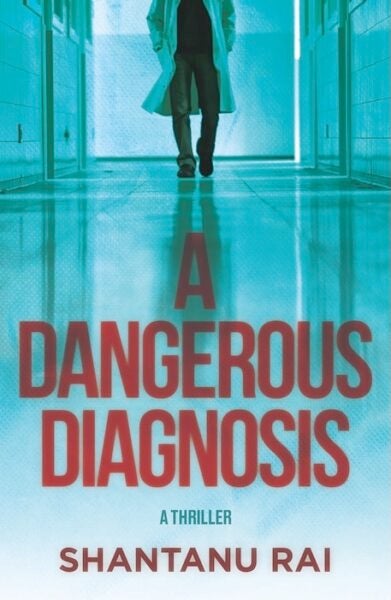
Check out Shantanu Rai's A Dangerous Diagnosis here:
(WD uses affiliate links)